
Ellie Silver is a Product Engagement Manager at a large healthcare technology company that serves some of the most prestigious health systems in the country. In her world, the product surface area is massive, regulatory constraints are a constant, and "simple questions" rarely have simple answers.
The High Stakes of "I Don't Know"
In healthcare tech, downtime isn't just an inconvenience—it’s a crisis. During a recent review, Ellie was hit with a deceptively difficult question:
"What are customers actually asking us to support during system downtimes?"
This wasn’t a hypothetical exercise. System downtime is the most vulnerable time for health systems and getting this right meant the difference between patient care and failure. For the company, providing the wrong answer leads to support bottlenecks and lost trust. The right answer? It streamlines operations and keeps clinicians focused on patients.
Turning to Arkweaver
The challenge wasn’t access to data. It was one of scale and intent. The information already existed across customer conversations, tickets, notes, and internal documentation. The problem was synthesizing it into something actionable. ChatGPT and Claude Code could not keep up with the scale of customer feedback without hallucinating or averaging all feedback into goop. It often mixed up requests from customers with sales pitches!
Using Arkweaver as a AI PM
Instead Ellie asked Arkweaver’s AI PM to look across existing customer inputs and surface patterns.
What came back was not raw text or a generic summary.
Arkweaver returned:
A clear list of five recurring customer needs during downtime
A short synthesis explaining why those needs showed up and which customers asked for them
Practical recommendations tied directly to those patterns
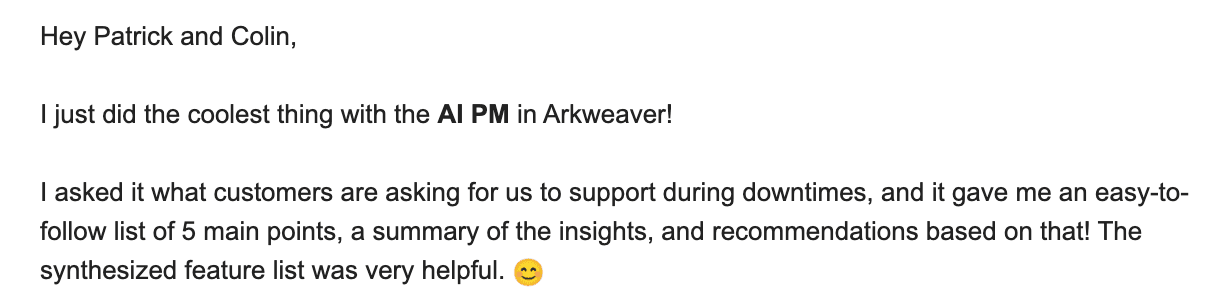
For Ellie, the value wasn’t just speed. It was confidence. The output reflected the same conclusions she would have reached after deep manual analysis, but without needing to reconstruct the context herself.
As she put it internally, the synthesized feature list was immediately useful.
Why This Matters for Enterprises
In high-stakes domains like healthcare, product decisions often depend on "tribal knowledge, someone remembering why a decision mattered six months ago. When that person leaves or a team shifts, that context is lost.
Arkweaver changes the math by:
Preserving Context: It remembers the "why" behind every ticket and note. It keeps a consistency to decisions that customers depend on.
Removing Guesswork: Decisions are backed by the full weight of existing data, not just the loudest recent feedback.
Speed to Insight: It turns days of research into minutes of synthesis.
In that environment, product decisions often depend on someone remembering why something mattered six months ago.
Arkweaver’s role in Ellie’s workflow wasn’t to replace judgment. It was to preserve and reassemble context so judgment could be applied faster and with less guesswork.
From Insight to Action
The output Ellie got wasn’t filed away. It informed internal conversations about what customers actually expect during downtime scenarios and where the product could better support them. It allowed the company to move 4x faster to live.
That’s the difference between analysis that lives in a document and analysis that feeds decisions.
For teams doing product work in regulated, high-stakes domains, that distinction matters.
Why Teams Use Arkweaver This Way
Arkweaver is useful in moments like this because it doesn’t treat product work as a writing problem. It treats it as a action problem. Insights are only great if they lead to better and faster action. Arkweaver does both.
Ellie didn’t need help drafting language. She needed help seeing patterns across messy, real-world inputs and turning them into something the team could act on.
That’s the kind of work Arkweaver is designed to support.
Ready to bring your ideal product to life?