
Three weeks, 495 commits, one very busy gremlin
Since October 13 we've pushed 495 commits to Arkweaver when combined represent the biggest evolution we've ever had. What started out as a Product Intelligence solution is now a Command Center for Sales Enablement, Product Marketers, and Revenue teams to help revenue grow with every feature.
If I had to sum up the stretch in one line: Arkweaver used to be really good at knowing what your customers asked for. Now it does a lot more of the product marketing work that comes after. Launches, one-pagers, decks, rep follow-up, telling the people who asked. Here's what shipped.
TL;DR
- Launch Hub: The easiest way to launch a whole new product in under a week with context, dates, plans, owners, and a two-way synced Notion table.
- Deliverables that sound like your company: Arkweaver learns your voice from your website and your own team's calls, borrows how your reps actually pitch, and prints PDFs in your brand.
- MCP + Chat that does things: Chat, Slack, and MCP can now send deliverables, file requests into Linear or Jira, find quotes, record feature interest, and send customer announcements, all with a confirm step before anything leaves the building. I use it to create 1 pagers in Figma from Claude.
- Sales enablement - who's not selling what?: Struggling with reps pitching only one product? We help you identify exactly who they are and help you solve it.
- Align with Quarterly Goals: Arkweaver now identifies your annual goal and quarterly focus, and weighs them when deciding $ product values, communications, and enablement material just like way a good teammate would before it decides what matters.
- A pile of accuracy work that nobody will ever notice, which is exactly the point.
The Launch Hub
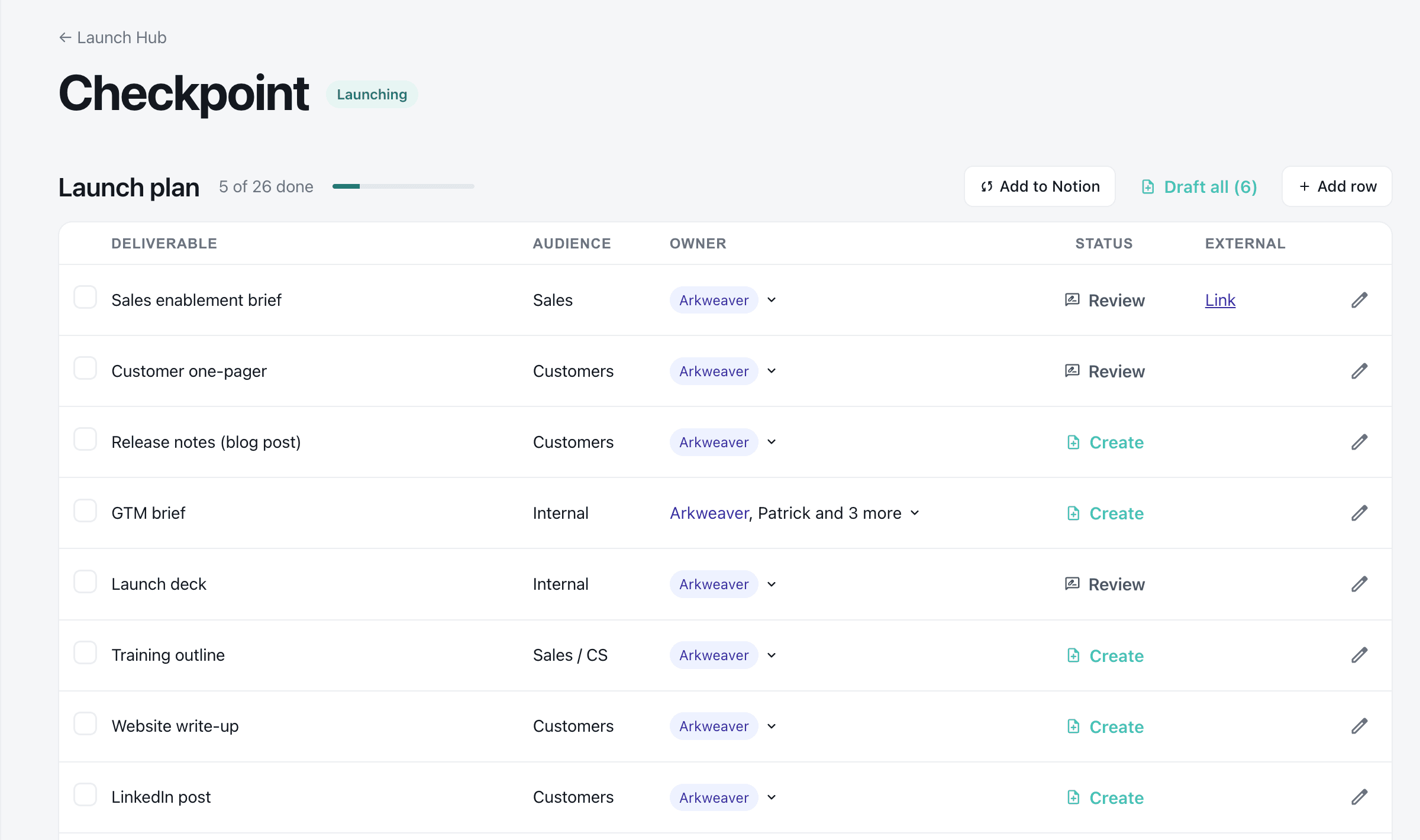
Real launches are rarely one feature. They're four features, two of which slipped, shipping to a pilot group on one date and everyone else a week later. So we built the Launch Hub. You pick the features that ship together, give the launch a name and optional dated stages, and its status follows the dates.
Every launch gets a launch context, a single plain-language page covering what's shipping, what's coming, who it's for, and a short always/never list for the copy. Arkweaver drafts it from your feature descriptions, your Linear tickets, and the customers who asked. Every deliverable for that launch gets written from that page, so you stop re-explaining the scope in every request.
The plan is an editable table of deliverables, audiences, owners, and due dates. Rows assigned to Arkweaver draft themselves. Close-the-loop rows tick themselves off when the emails actually go out. You can mirror the whole thing into Notion as a two-way synced table, and owners finally show up as real names. There's also a green Launch button on every feature card now, because three clicks was two too many.
Marketing + Enablement that sound like you
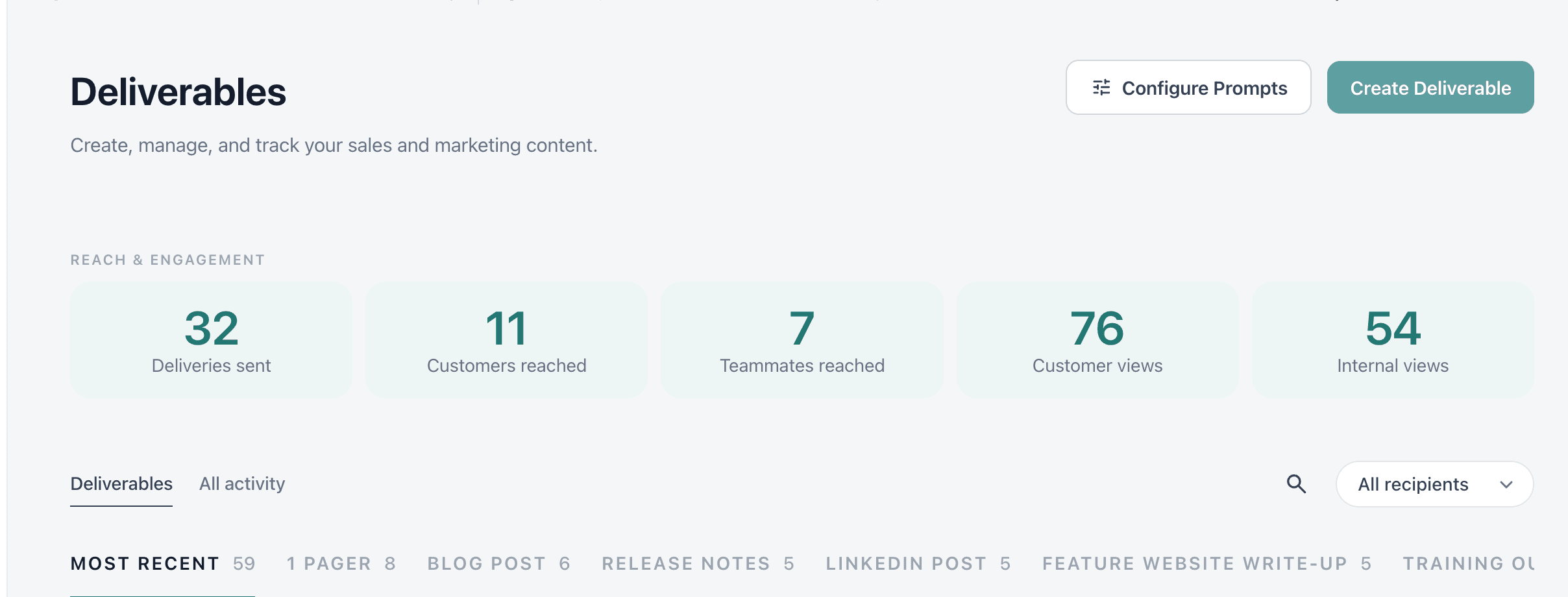
This is where most of the commits went, and honestly it's the part I'm proudest of. The old one-pagers read like a feature list written by someone who had never met your customers. Now:
- Arkweaver works out your company's voice from your website and what your own staff say on calls: what you call your customers, the terms you use, your tone.
- It borrows your team's pitch language: It reads how your reps actually describe a feature across Gong calls, keeps only phrases said word for word, and ranks them by how many calls used them. If your best rep has a one-liner that lands, your one-pager can use it.
- Golden examples: Hand Arkweaver a PDF of the best one-pager you've ever made. It reads the layout and brand and prints future deliverables to match, including two-page versions.
- An AI-slop check. Yes, we built an AI-slop detector into an AI product. It catches banned words, dashes, and structural patterns, then runs one rewrite. A rewrite that drops figures or links gets thrown out.
- Analysis of which prompts are most viewed and used!
If you've read how AI is speeding up shipping faster than product marketing can keep up, this is our answer to it. The first draft should be one you'd actually send.
Chat that actually does the work
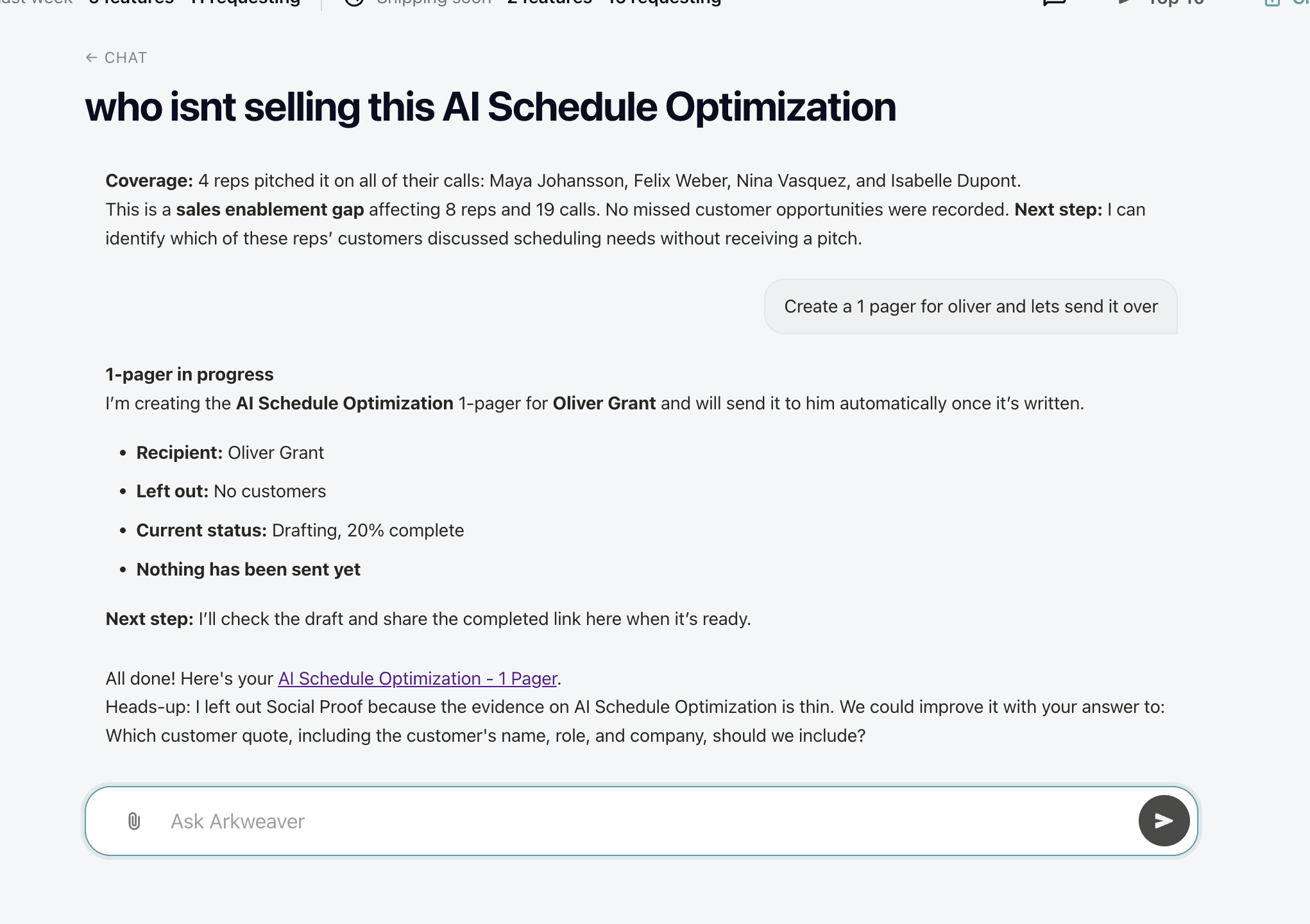
As we've always said, we don't want you to have to login to Arkweaver and (psst) we don't either. We usually use MCP. But, when you do, you'll see Chat is now the home page in Arkweaver, and it got a lot more capable. Anything you can do with a button, you can ask for in chat, in Slack, or from Claude or Cursor over MCP:
- Build deliverable across several features, then edit it from a chat that sits right next to it - in Claude I connect them with Figma and Canva's MCPs to make some amazing work.
- Send any deliverable to teammates over their own channel.
- File customer requests into Linear or Jira: we got a lot of people still loving the old way of submitting feature requests, so we oblidged.
- Find a verified customer quote for anything
- Draft and send "it shipped" announcements to the people who asked. Sends are tied to the exact list you previewed, and nothing goes out on the first call.
Two small ones I love. While chat is working, each step now shows up with a gremlin doing the job. And in Slack, Arkweaver acknowledges your message with 👀 right away, so you're not left wondering if it heard you. People who signed themselves up can now ask questions in Slack too.
Sales enablement: who isn't pitching what
The Launched But Never Sold report is all about features that ship and then never get pitched. So we built rep coverage into the product. Ask Arkweaver who's selling a product line and it shows every rep's calls, how many of them included a pitch, and when they last pitched it. Then it lists the missed chances: calls where a customer described a need for that product in their own words and nobody pitched it, with the quote and the reps who should have.
That's the gap I wrote about in why sales teams don't pitch half of new features. Now enablement can see it by name and coach the right reps instead of retraining everyone. Launch emails also got a demo link and a screenshot, so the reps who do read them have something to show.
Company goal context
A good PMM doesn't treat every feature the same. They know this quarter is about expansion, or a new segment, or saving renewals, and they make calls with that in mind. We wanted Arkweaver to work the same way.
So Arkweaver now works out your company's annual goal and up to three weighted quarterly focuses from your CRM and calls, along with the market segment behind each one and where your renewal dates live. It shows them on your company profile, and you can correct them in plain words from chat ("our focus this quarter is expansion"). From there it ranks the roadmap against what you're actually trying to hit, so the features that move this quarter's goal rise to the top.
We also added CRM account owners as people who hear about a launch, a person profile with buying role and objectives, and proper speaker detection for Fathom and Granola calls, so it knows who on the call was the customer even outside Gong.
The boring stuff that makes the rest trustworthy
A big chunk of these commits were accuracy work. Not glamorous, but it's the reason you can trust the rest.
- Blockers and workarounds only count when a confirmed customer said them. "We promised that" only counts when your own team said it.
- Linear projects and their issues now come in as tickets, so matching a request to the right card has more to go on. (Linear is our partner and this made the matching noticeably better.)
- Opportunity maps now refresh once a day. They used to refresh every minute, which in hindsight was a lot of minutes.
Want to see it on your own calls?
That's the three weeks. If you missed the last round, here's what we shipped in August. And if you'd like to watch Arkweaver turn your own calls into a launch, a one-pager, and a list of reps to nudge, grab a demo.
FAQ
What is the Arkweaver Launch Hub?
It groups related features into one named launch with dated stages, a shared launch context, and an editable plan of deliverables and owners. The plan can sync both ways with a Notion table.
Can Arkweaver write deliverables in my company's brand and voice?
Yes. It infers your voice from your website and your team's own calls, reuses the wording your reps actually pitch with, and can print PDFs that match a golden example you upload.
Will Arkweaver send anything to customers without asking?
No. Announcements and tracker filing both show you exactly what would go out first, and nothing is sent or filed until you confirm that list.
How do I see which reps aren't pitching a product?
Ask Arkweaver who's pitching a product line. It shows each rep's pitch rate and last pitch, plus the calls where a customer described the need and nobody pitched it.