
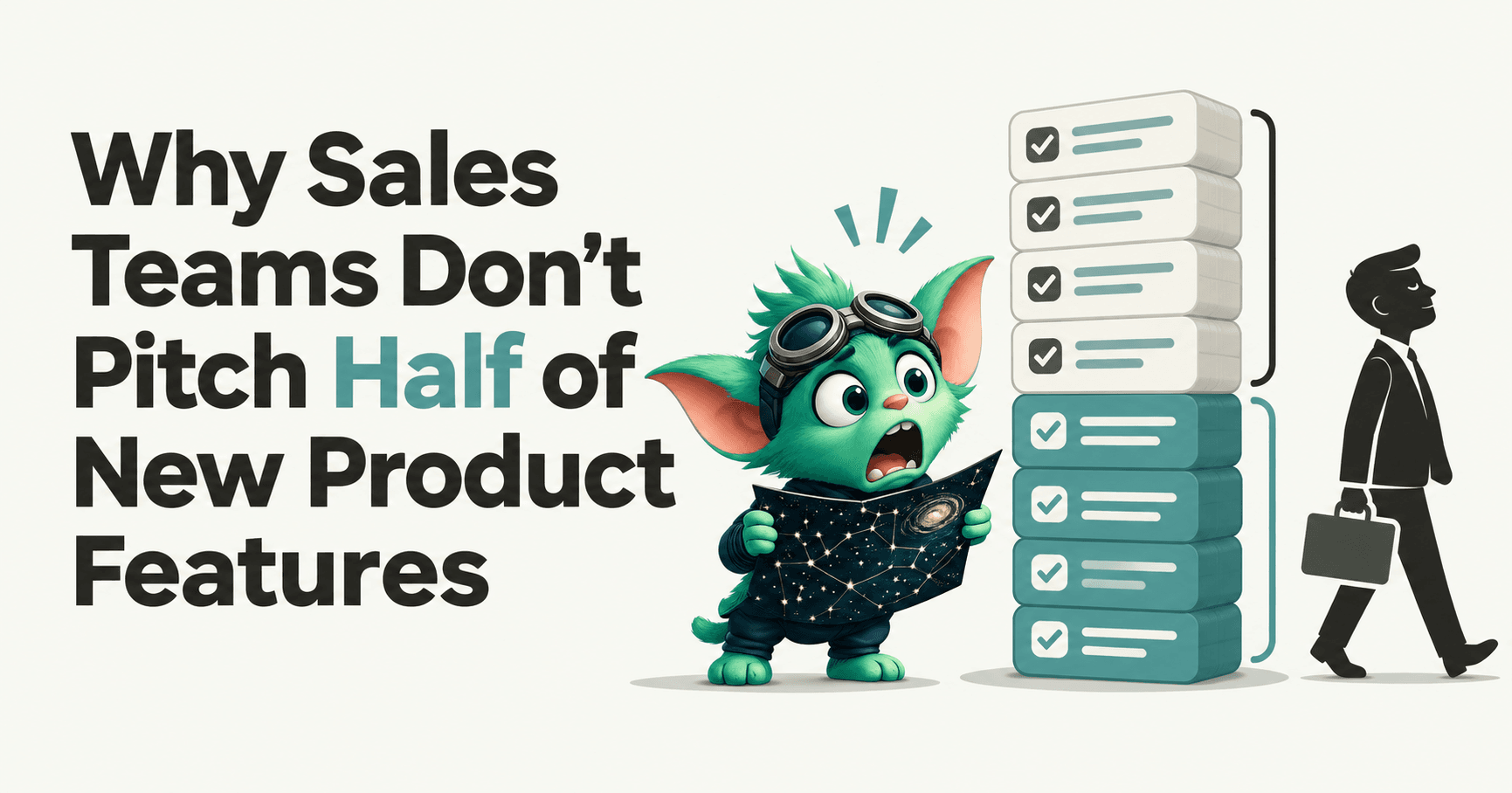
Why don't sales teams pitch half of new product features?
Because nobody connects the feature request to the engineering work then to the specific reps and deals that need it. In our analysis of over 1,000 hours of sales calls, 50% of launches were never mentioned by the sales team in the 90 days after they shipped. It isn't that reps are lazy. It's that launches historically are blasted to everyone.
This is one piece of a bigger study. The full numbers and methodology are in Launched But Never Sold: The 2026 State of Feature Sales Coverage. Here I want to dig into what it means if you run sales enablement.
What does "half of new features" actually look like on calls?
- 50% of launches were never mentioned by the sales team in the first 90 days.
- 53% of the shipped portfolio had zero customer-call mentions in the last 90 days.
- The top 10% of features get about 65% of all feature talk on calls. This can help explain why 80% of features are seldomly used.
- The first mention, when there is one, comes a median of 17 to 29 days after launch.
- Only about 31% of launches get mentioned in the first 30 days.
So reps aren't ignoring features at random nor are they frequently selling things they shouldn't. It's a knowledge gap, they simply do not know OR do not know the relevance of a new launch. If you sell multiple products, especially after an acquisition, that's the same pattern at a bigger scale: a couple of products carry the number and the rest sit on the shelf.
Why does this happen?
- Reps only have room for about three features per call: Reps mention 3.2 to 3.4 features per call, and about 2.3 of those are things that have actually shipped. Every new launch is competing for one of those slots against features the rep already knows how to sell.
- The gap between reps is huge: Top-quartile reps mention roughly 2 to 3 times as many shipped features per call as bottom-quartile reps. Your average pitch rate hides that half your team is selling a much smaller product than the other half.
- Broadcasting doesn't work: Release notes, all-hands demos and enablement decks go to everyone. It's been intuitive that this didn't work, but there haven't been lots of alternative options. Reps who don't see an obvious deal for a feature tune it out, and honestly that's rational. Remember, they are the only role who's majority of pay is based on performance. This lines up with something I wrote about before: a missing feature is the #1 reason top reps lose deals, and to a buyer, a feature the rep never mentions might as well be missing.
What actually gets a feature pitched?
Getting the feature to the right rep. Plain and simple. Arkweaver's alerts reached the reps who were 8x more likely to pitch the feature: reps mentioned 24% of launches they were alerted about, against 3% of everything else. The hard part of enablement isn't the messaging its the audience. In sales, it's often said that relevance is more important than personalization. That's the exact same here! It's knowing which rep, which deal and which feature belong together.
Even then, about a quarter of alerts turn into a pitch within 30 days, and 58% of alerted reps pitched at least one feature they were told about.
What should sales enablement teams do?
- Measure pitches: For every launch, track which reps mentioned it on relevant calls in the 30 days after shipping. That's the number that tells you if enablement worked. More on this in how to measure product marketing success.
- Build a rep by product view: One row per rep, one column per product or feature, filled with who has pitched what. The empty cells are your coaching list (or just use Arkweaver's MCP).
- Route launches to reps: Send each feature to the reps whose open deals or accounts asked for it, with the account names attached. Relevance is king.
- Coach the bottom quartile on breadth: If your best reps cover 2 to 3 times as many shipped features, the fastest win is getting the rest of the team to talk about more of what you've built.
- Plan for AI-speed shipping. If engineering is shipping weekly, this problem gets worse every month. I covered that in sales enablement strategy when AI speeds up feature shipping.
This is what Arkweaver does: it reads your calls, ties every feature to the reps and deals that need it, and shows you who actually pitched it.
FAQ
What percentage of new features do sales teams pitch?
In our analysis of 1,000+ hours of sales calls, 50% of launches were never mentioned by the sales team in the 90 days after shipping. Only about 31% were mentioned within the first 30 days.
How many features does a sales rep mention per call?
About 3.2 to 3.4 features per call, of which about 2.3 are shipped features. Top-quartile reps mention roughly 2 to 3 times as many shipped features as bottom-quartile reps.
How do I know which products my sales reps aren't pitching?
Use call recordings, not CRM fields or content downloads. For each product or feature, check which reps mentioned it on calls where it was relevant. A rep by product grid shows the gaps quickly.
Do rep alerts get features pitched more?
Alerts in our data reached reps who were 8x more likely to pitch the feature, mostly because they went to reps already in relevant conversations. The value is in targeting the right rep, not in the notification itself.