
You’ll Never Believe Why Top Sales Reps Actually Lose Deals
(I didn’t, either)
I've search the internet far and wide to answer a single question: What is the #1 reason sales reps lost deals in enterprise software? Most of the answers were promotional content or lacked statistical rigor. I finally found one and the results actually shocked me.
I shared this stat with a senior sales executive recently. Someone who has been in the game a long time. Built teams. Run big numbers. He didn’t believe me.
The #1 reason top-performing sales reps lose deals is lack of features.
(I honestly wish I had known this in my last startup.)
That insight comes from the Ebsta Pavilion B2B Sales Benchmarks 2024 report, which analyzed millions of real B2B opportunities across hundreds of companies.
And once you see it, you can’t unsee it.
A Bit about the Study
"This year we analyzed 4.2 million opportunities, 1m+ hours of conversations, from 530 companies, representing over $54 billion in revenue."
The study then broke out the differences between what an average rep said cost them the deal and what a top rep did. This was eye opening (but obvious in hindsight). Who do you want to copy? Everyone or the top rep, you want to copy the top rep!
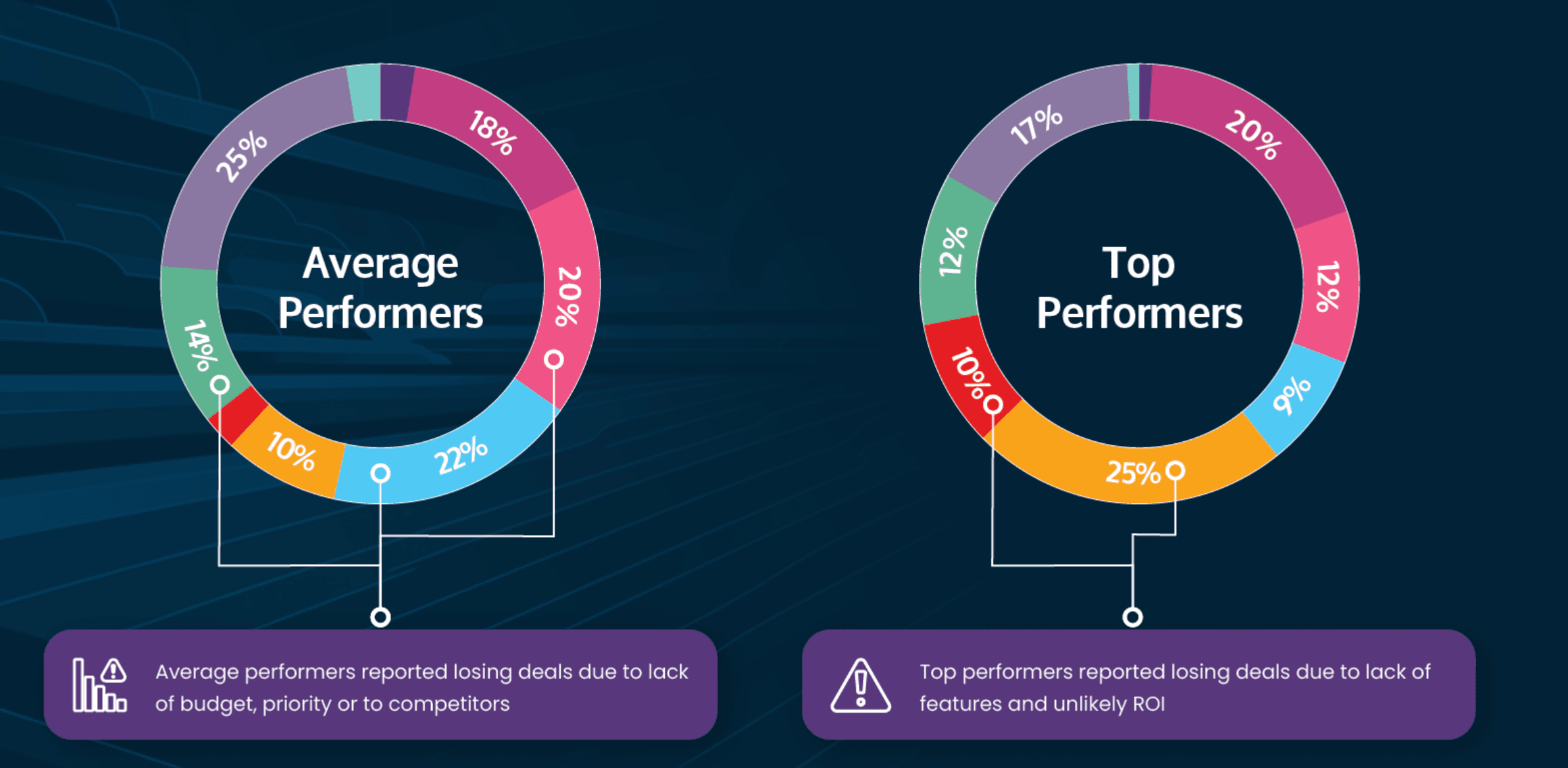
Wait, lack of features?
Yes.
Not price. Not competition. Not poor objection handling.
Top performers still lose deals. When they do, the most common reason is that the product is missing something the buyer needs. Most average reps don't get that far in the sales process.
The job to be done changes now. It's no longer improving adherence to MEDPICC, its making sure that your top reps have the features they need to sell. It's why we have a playbook for CROs I highly recommend.
Because for years, we have told ourselves a comforting story. If deals are lost, it must be a sales execution problem. Better discovery. Better qualification. Better closing.
It does not hold for elite ones.
Why this surprised even experienced sales leaders
The people who outperform quota year after year are very good at their craft. They know how to run discovery. They know how to position value. They know when to walk away.
When they lose, it’s rarely because they failed to explain something.
It’s because the buyer asked, “Can your product do X?”
And the honest answer was no.
That moment ends deals quietly. Sometimes politely. Sometimes weeks later with a “we decided to go in a different direction” email.
No amount of follow-up fixes it. The answer is NOT more meetings.
The uncomfortable implication for founders and executives
If top reps are losing deals due to missing features, that is not a sales problem.
It is a product feedback problem that is failing to reach the roadmap.
Think about what that means in practice.
Your best reps are hearing the market clearly.
They are encountering real buying friction.
They are bringing back signals that directly correlate with revenue.
And most companies do not have a reliable system to capture, prioritize, and act on that information.
I’ve lived this.
At QueueDr, we lost deals that made perfect sense in hindsight. Sales told us what they were hearing. Product heard it, but through summaries, anecdotes, and memory. By the time patterns emerged, competitors had already shipped.
That lag is expensive. You just don’t see the bill right away.
Why “lack of features” is actually a great signal
Here’s the part that should make you optimistic.
When a deal is lost because of missing features, it means a lot went right.
The buyer cared enough to evaluate deeply.
The sales rep earned enough trust to hear the real objection.
The product was close enough to be considered.
This is not random churn. This is structured demand.
But only if you treat it that way.
Most companies don’t. They log “product gap” or lets be honest, "ghosted", in a CRM field and move on. No context. No call clips. No pattern recognition across dozens or hundreds of conversations.
Which means the same deal gets lost again next quarter.
This is where sales and product quietly drift apart
Sales teams speak in hitting numbers.
Product teams ask a lot of questions.
The translation layer between those worlds is fragile. Always has been.
So when sales says, “We’re losing deals because we don’t have X,” product hears noise. Or one-off requests. Or enterprise edge cases.
Meanwhile, the benchmark data is screaming that this is systematic.
Top performers do not lose deals randomly.
A CRO's New Job to Be Done
First, a CRO needs to accept this reality. Done? Good.
Second, think of your job as not winning customers' hearts, but winning internal debates with Product.
Instead of asking your team, “Why did we lose this deal?”
Ask something more specific.
“What feature came up in the last ten lost deals that mattered enough to stop momentum?”
If you cannot answer that with evidence from real calls, you are guessing.
Finally, it's not just enough to know the feature, its learning how to communicate it in Productese, something Arkweaver speaks fluently.